
James Higgins, MD, FAAP – Exceptional Pediatrician, Outstanding Football Player and Victim of an Early Death from Chronic Traumatic Encephalopathy (CTE)
James Higgins, MD, FAAP – Exceptional Pediatrician, Outstanding Football Player and Victim of an Early Death from Chronic Traumatic Encephalopathy (CTE)

As September approaches, the fall sports season is about to begin. Sports injuries—especially sports-related brain injuries—have long been a major medical interest of mine. While many sports can cause brain injuries in pediatric patients, most of these injuries occur from tackle football. Concussions are the best-known sports-related brain injury, but an increasing concern in tackle football is the repeated sub concussive head impacts that occur throughout a season.
The effects of subconcussive brain trauma were brought to the forefront this spring when the second physician to join Pediatric Associates of Greater Salem, James Higgins, MD, was identified as having Grade IV CTE on his postmortem brain examination.
Many families with children age seven or older likely knew Dr. Higgins well. For families newer to PAGS, I would like to briefly introduce him and describe the profound influence he had on the founding and growth of the exceptional practice we are all part of today.
Dr. Higgins graduated from Harvard College in 1970 and Harvard Medical School in 1974. After completing his pediatric training at Boston Children’s Hospital and Massachusetts General Hospital in 1978, he joined Ayres D’Souza, MD, at Pediatric Associates of Greater Salem, the practice Dr. D’Souza had founded the year before. During his remarkable 42- year career, he provided care for patients during approximately 250,000 outpatient visits and attended roughly 10,000 deliveries at Salem Hospital.
Beyond his work at PAGS, he was instrumental in creating a Level II Special Care Nursery at Salem Hospital, expanding care for sick newborns throughout the North Shore area.
The impact he had on countless patients and families during more than four decades of practice is immeasurable.
In 2020, he started to notice problems with his speech and was diagnosed with aphasia leading him to retire from the practice of medicine. His aphasia evolved into
Dementia, which lead to his death on May 11, 2025, at the age of 76.
In addition to his exceptional work as a pediatrician, Dr. Higgins was an accomplished football player. He began playing tackle football in sixth grade, became an All-State cornerback at Livingston High School in New Jersey, and later played for the Harvard football team. After he was diagnosed with aphasia, he and I discussed the possible connection between contact sports, including football, and neurodegenerative disease.
In a final effort to advance medical knowledge, Dr. Higgins chose to donate his brain and spinal column to the Boston University Chronic Traumatic Encephalopathy (CTE) Center. BU neuropathologists completed their evaluation this spring; they determined that he had Grade IV CTE at the time of his death. CTE is graded from I to IV, with I being the mildest form and IV the most advanced.
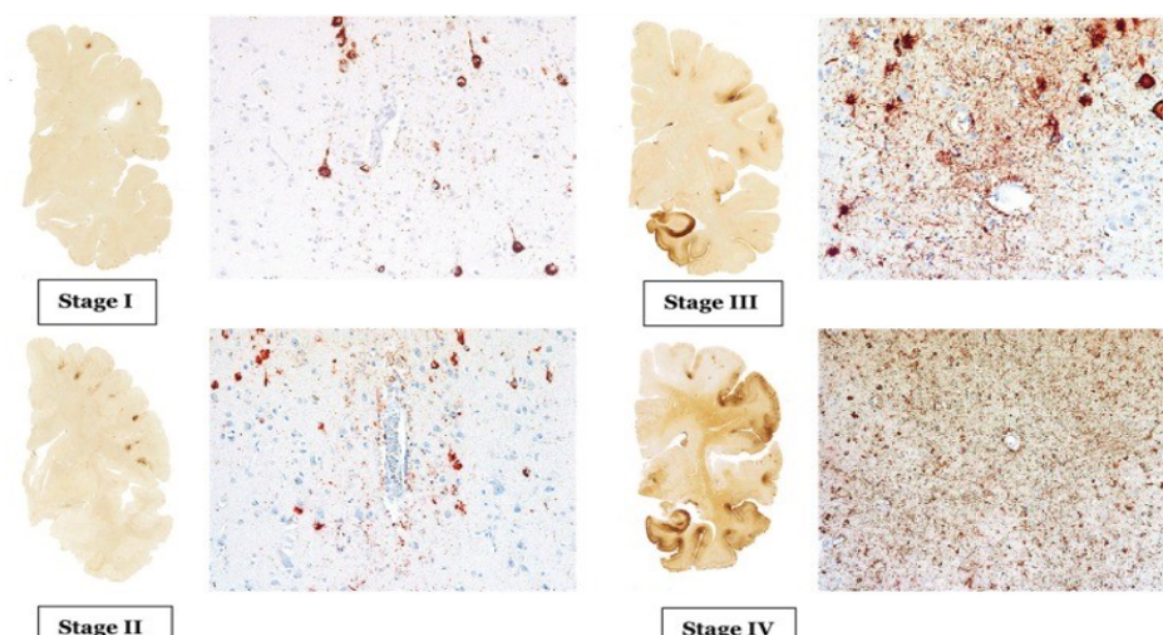
Chronic traumatic encephalopathy (CTE) is a progressive brain disease caused by repeated head hits. It leads to a buildup of abnormal tau protein (the brown stained areas in the above brain pictures), cell death, and shrinking brain tissue.
Although CTE is often associated with NFL-level football players, the BU CTE Center has found evidence of the disease in many athletes whose football careers ended in college, including Dr. Higgins, as well as in some who never played after high school. The youngest football player identified with CTE at autopsy was a 17-year-old high school athlete.
Dr. Higgins was a tireless advocate for his patients. I hope his untimely death from CTE encourages the pediatric community to place greater emphasis on youth head safety, especially by postponing tackle football until age 14, which is when most athletes begin high school, and by encouraging flag football for younger children. This approach lets children learn the game, stay active, and gain the character-building benefits of team sports while greatly reducing sub concussive trauma to the developing brain before age 14.
Massachusetts is fortunate to be home to many of the world’s leading experts on sports-related brain trauma and CTE, including Chris Nowinski, PhD, who has conducted groundbreaking CTE research since 2003. After learning of Dr. Higgins’s Grade IV CTE diagnosis, I spoke with Dr. Nowinski, who noted that Dr. Higgins was not The first Harvard football player diagnosed with CTE; however, he believes Dr. Higgins may be the first pediatrician identified with the disease.
One of Dr Nowinski’s current efforts is the “Flag Football Under 14” initiative through the
Concussion and CTE Foundation.
https://concussionandcte.org/programs/flag-football/
In a 2019 paper published in Annals of Neurology, the BU CTE team reported that CTE risk was linked to the number of years an athlete played tackle football, as opposed to the number of concussions sustained. Their research found that each additional year of tackle football increased CTE risk by 30% and that the risk doubled after every 2.6 years of play.
Even when performed with proper technique, tackling and blocking in football expose each player to an estimated 200 to 500 sub concussive head impacts per season, depending on position. Youth tackle football produces more repetitive head impacts than any other youth team sport in the United States. Each year, roughly 2 million youth football players experience nearly 1 billion sub concussive head impacts during games and practices.
The “Flag Football Under 14” initiative aims to reduce the total number of sub concussive head impacts in youth football. Delaying tackle football until age 14 gives the brain more time to develop, and it also allows athletes’ neck muscles to grow stronger, reducing the “bobblehead” effect that can occur when younger players are hit on the head and potentially increasing subconcussive trauma to the developing brain.
The BU CTE Center has estimated that an athlete who starts playing tackle football at age 5 versus age 14 has 10 times the risk of developing CTE over their lifetime. If all youth football players were to start tackle football at age 14, this change alone would prevent 50% of future CTE cases.
Flag football offers the same opportunities for exercise and team-based character building as tackle football while greatly reducing head impacts. Instead of the 200 to 500 sub concussive head impacts experienced by youth tackle football players each season, the average youth flag football player sustains roughly eight. Some argue that players must begin tackle football before high school to become elite athletes; I would counter that Tom Brady, widely regarded as the NFL GOAT, did not begin playing football of any kind until ninth grade.
Dr. Higgins played 10 years of tackle football: three years in youth football, four years in high school, and three years at Harvard. I believe that if he had waited until high school to begin playing—or had chosen tennis instead—he might still be practicing with us today.
I encourage every family reading this message to seriously consider delaying tackle football until age 14, the typical age of starting high school. Current research on sports-related subconcussive brain trauma suggests that postponing tackle football can significantly benefit an athlete’s long-term neurocognitive health.
Donald T McAuliffe Jr MD
Pediatric Associates of Greater Salem
Salem, MA
For those who are age 14 and older and playing high school contact sports here are some resources for products that can reduce the severity of sub concussive forces delivered to the brain. No product can provide complete safety against concussions and subconcussive forces applied to the brain, but there is sports equipment that can provide added safeguards.
- Helmets
Virginia Tech University has been testing helmets for football and other sports since 2011. https://www.helmet.beam.vt.edu/
They have a star rating system with 5* being the best rated down to 0*. For football they rate varsity and youth football helmets.
I would strongly advise ensuring that all football players wear a Virginia Tech 4 or 5* rated helmet. Price does not equate to the star rating. In the varsity football helmet category, the cost of a 5* Light Apache Tomahawk helmet is $299 and the cost of a 1* rated Schutt F7 helmet is $649.
Many teams provide helmets to the players. If a player is given a team provided helmet, I would confirm that it is a 5* rated helmet.
It should not be older than two years old, and if it is two years old, it should have a label indicating it has been reconditioned after the Second Season. In that the average high school football players' helmet is going to receive upwards of 500 impacts per season, I would recommend purchasing a new helmet for each season. If a pair of Nike football cleats can cost $150-200, investing a slightly higher amount at $299 for the Light Apache Tomahawk model and ensuring the highest level of protection for the brain each season is a valuable investment.
This is a guide for parents regarding football helmets: https://www.usef.org/forms-pubs/er_NZblpVRQ/2026-april-trending-article
- Helmet Shell Add Ons
Helmet covers are a newer product that adds additional protection to the brain from concussive level and sub concussive level trauma. The helmet shell covers can be thought of the easiest with the following scenario; if you know you are going to get punched in the head, would you rather receive that punch fist to skull or fist covered in protective foam and your head covered with foam?
The helmet covers are not star rated because there are currently only 3 models to choose from. The following is the Virginia Tech statement regarding the helmet covers:
"Helmet shell add-ons have been shown to decrease linear and rotational acceleration, thereby helping to reduce risk. However, there are notable differences between various add-ons, so the specific model used is important to consider. Moreover, the effectiveness of these add-ons can vary significantly depending on the helmet model. The helmet model itself is crucial as it sets the baseline level of protection. While helmet shell add-ons can enhance a helmet’s performance, it's important to note that a poor-performing helmet With an add-on may not perform as well as a high-performing helmet without an add-on.
- Soccer caps and headbands can reduce forces being applied to the brain tissue while playing soccer either by heading the ball or head-to-head impact during a game. Typically, the caps are worn by goalkeepers and the bands by the other players. The soccer head protection is star rated and I would pick a 4 or 5* rated model. As in football, my medical recommendation for soccer players would be to avoid heading the soccer ball until reaching high school / age 14.
- The Virginia Tech lab has also rated hockey helmets, snow sport helmets, bike helmets, flag football bands and caps and equestrian helmets.
For those parents working in the construction trades, Virginia Tech has also tested and rated construction helmets.