
Feeding Your Selective Eater: When Is It ARFID? Our Dietitian Explains
If mealtimes with your child feel like a daily battle, you are not alone. Feeding a child who is a selective eater can be stressful, and at times it may even feel hopeless. The good news is that with patience, structure, and the right support, you can help your child build a healthier relationship with food.
What Is Selective Eating?
Selective eating is a more neutral term for “picky eating.” It is a common and normal phase of childhood. Many children go through stages of preferring certain foods and rejecting others.
Common signs include:
- Preferring familiar foods
- Avoiding certain textures or new foods
- Still eating enough to grow and follow their growth curve
- Showing interest in trying new foods over time
The encouraging part is that most selective eaters expand their food choices as they grow, especially with gentle, consistent support at home.
Helpful Tips for Selective Eaters
- Avoid strict food restriction.
- If your child asks for cereal and you oppose, try a compromise. A whole grain option like Kashi Organic Honey Toasted Oats or Frosted Mini-Wheats is a healthier swap for Lucky Charms. If your child eats cereal often and you just cut it out, it can cause a decline in weight
- Offer repeated exposure.
- A child may need many tries before accepting a new food, so keep offering it without expectation.
- Eat together.
- Family meals and role modeling show your child that trying new foods is safe and enjoyable. Try to have your child help in the kitchen.
- Skip the pressure.
- Avoid forcing, bribing, or pressuring your child to eat.
- Keep it positive and structured.
- Regular meal and snack times and a relaxed atmosphere help everyone. Mealtime should be enjoyable for the whole family!
What Is ARFID?
Avoidant/Restrictive Food Intake Disorder (ARFID) is an eating disorder. It goes beyond typical selective eating and can affect a child’s health and growth. It is a relatively new diagnosis in the Diagnostic and Statistical Manual of Mental Disorders, 5th edition (DSM-5). It replaces what used to be called “Feeding Disorder of Infancy or Early Childhood.”
Signs of ARFID may include:
- A limited range of accepted foods that decreases over time
- Strong fear of choking, vomiting, or certain textures
- Avoiding foods based on smell, texture, or appearance
- Eating too little to meet energy needs
- Weight loss or poor growth
- Nutritional deficiencies
- Gastrointestinal complications
- Eating challenges that get in the way of daily life, such as school or social events
According to the American Psychiatric Association, conditions such as autism spectrum disorder, ADHD, anxiety disorders, and depression commonly occur alongside ARFID.
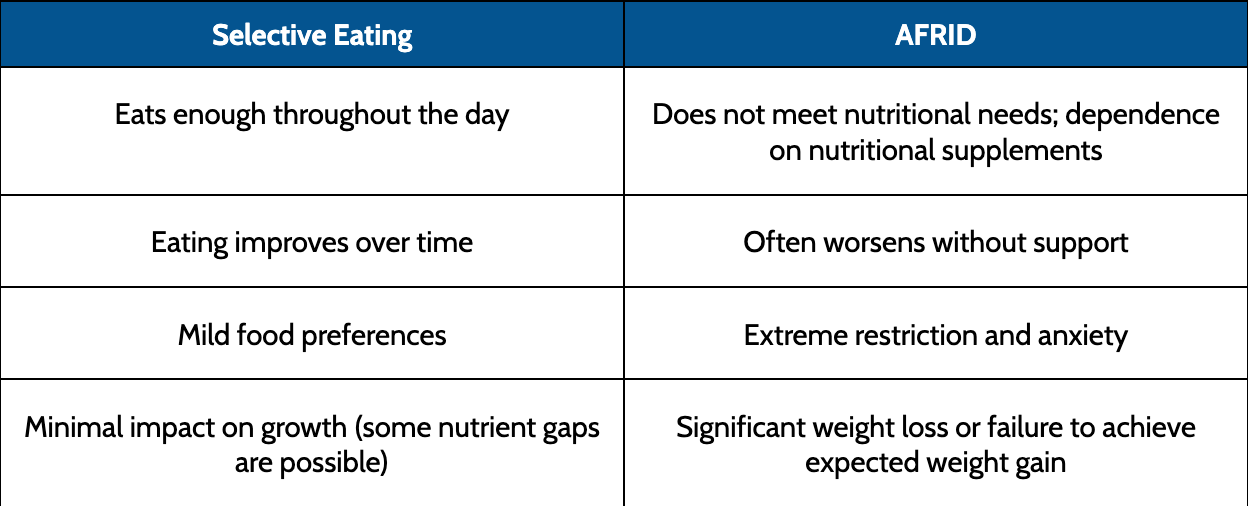
Key Differences at a Glance
The biggest difference is that selective eating is a normal developmental phase. ARFID is a clinical eating disorder, and only a trained professional can diagnose it. Knowing the difference helps make sure your child gets the right kind of support.
When Should Parents Reach Out?
Consider talking with our dietitian or your child’s healthcare provider if your child:
- Is losing weight or not growing as expected
- Eats a limited number of foods and the list is decreasing
- Will only eats certain textures of food or avoids food groups
- Shows strong anxiety around eating, especially in social settings
- Gags or refuses food regularly
How Is ARFID Treated?
The hopeful news is that ARFID is treatable. Care often involves a team that may include a pediatrician, a registered dietitian, and a licensed therapist or psychologist. Reaching out early is a sign of strength, not failure. The sooner your child has support, the easier the path forward.
Treatment may include:
- Nutrition therapy to support growth and fill nutrient gaps
- Gradual, safe exposure to new foods
- Strategies to address anxiety or sensory concerns
Tips for Parents
Whether your child is a selective eater or is working through ARFID, your role matters more than you may realize. Try to:
- Stay calm and supportive at meals
- Avoid forcing or pressuring your child to eat
- Offer a variety of foods regularly, including at least one “safe” food your child accepts
- Celebrate small wins, like touching, smelling, or tasting a new food
- Take care of yourself, too, because your calm presence helps your child feel safe
- Seek help early if you have concerns
If you have concerns about your child’s diet and/or growth? Reach out to us to schedule a consult with Liana DeLoid.
Liana DeLoid, MS, RD, LDN
Pediatric Associates of Greater Salem
Sources:
American Psychiatric Association. (2013). Diagnostic and statistical manual of mental disorders (5th ed.). https://doi.org/10.1176/appi.books.9780890425596
Brown, C. L., & Perrin, E. M. (2021, August). Defining picky eating and its relationship to feeding behaviors and weight status. Journal of Behavioral Medicine. https://pmc.ncbi.nlm.nih.gov/articles/PMC7737340/
Hanigan, A. (2024, August 22). Understanding avoidant restrictive food intake disorder (ARFID). Children’s Hospital of Orange County (CHOC) Children’s Health Hub. https://health.choc.org/understanding-avoidant-restrictive-food-intake-disorder-arfid/
National Eating Disorders Association. Avoidant/Restrictive Food Intake Disorder (ARFID). https://www.nationaleatingdisorders.org/learn/by-eating-disorder/arfid
Ramirez, Z., & Gunturu, S. (2024, May 1). Avoidant restrictive food intake disorder. National Library of Medicine. https://www.ncbi.nlm.nih.gov/books/NBK603710/
Cleveland Clinic. (2023, April 4). What is ARFID (avoidant/restrictive food intake disorder)? https://my.clevelandclinic.org/health/diseases/24869-arfid-avoidant-restrictive-food-intake-disorder